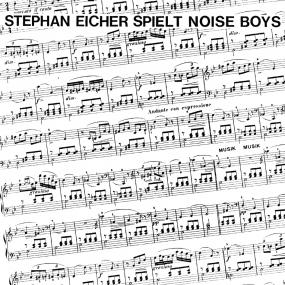
SPIELT NOISE BOYS - WHITE VINYL REPRESS by STEPHAN EICHER
| SKU | 143043 |
| Artist | STEPHAN EICHER |
| Title | SPIELT NOISE BOYS - WHITE VINYL REPRESS |
| Label | BORN BAD RECORDS |
| Catalog # | BB 024LP-BW |
| Tag | |
| Release | W 03 - 2026 |
| Format | Vinyl - EULP |
| EAN Barcode | 3516628500718 |
| Benelux exclusive, Import | |
| € 28,50 | incl. VAT, excl. shipping |
Tracks
- Disco Mania
- MiniMiniMiniMinijupe
- Noise Boys Song
- Hungriges Afrika
- One Second Too Late
- Sweet Jane
- Ping Pong Lied
Description
Reissue of Stephan Eicher's extremely rare early Electro Punk recordings (1980)
THINK GRAUZONE Meet SUICIDE meet DAF.
Taken from a cassette tape released in 25 copies in 1980, these tracks, recorded hastily on a dictaphone and stolen equipment, already hint at the success that Stephan Eicher would enjoy with his brother the following year and the GRAUZONE project (remember their hit “Eisbar”).
In short, cheesy synths, haunting vocals, and tortured drum machines... discover the dark side of Stephan Eicher!
-------------------------------------------------
Münchenbuchsee, a suburb of Bern, Switzerland. Stephan Eicher is the youngest of three children. His father, a radio and television repairman, is also a jazz violinist and a sound tinkerer in his spare time. In the family home’s repurposed nuclear fallout shelter–turned recording studio, Mr. Eicher wrecks homemade sequencers, tortures DIY drum machines, and abuses reel-to-reel tape recorders under the amazed gaze of young Stephan.
The boy quickly develops a strong musical curiosity through countless sonic experiments and wanderings. Together with his younger brother Martin, Stephan cobbles together small audio plays on a homemade multitrack machine (several cassette players mounted in series!)—plays they write, record, add sound effects to, and perform before sharing them with friends and relatives. Nice little lads, all in all…
It wasn’t until 1972, when Lou Reed released Transformer, that the Eicher siblings took a decisive turn. For Stephan (then 13), it was a revelation, and “Vicious” (the album’s opening track) occupied his turntable for months on end. He convinced his father to buy him an electric guitar. In the process, his father couldn’t resist building him a tube amplifier out of an old repurposed radio.
Then came adolescence. A difficult one. Stephan left home at 16 and moved to Zurich. Gifted with undeniable artistic talent, he persuaded his drawing teacher to help him get into F+F School—an alternative, radical version of the Fine Arts academy—despite his young age. Accepted, he immersed himself in video techniques, determined to become a filmmaker.
At F+F, Stephan organized Dada-style happenings and concerts with a small group of friends called Noise Boys. Among them were one of his teachers on bass; Veit Stauffer on drums—who would later found the Rec Rec label; his girlfriend Sacha on vocals; and Stephan on guitar. During one of their first performances, they devised a remote-controlled mouse covered in dulled razor blades and sent it into the crowd to create panic and chaos. Continuing this commitment to aggression and dissonance, they also performed wearing headphones blasting Tristan und Isolde while attempting to play their songs, all in pursuit of maximum cacophony. The goal was always to empty the room. Their “songs,” if the term applies, were of the same spirit—like “Hungeriges Afrika,” played exclusively with power drills and drum-feedback noise.
Because one must eat, Stephan returned to Bern on weekends, where he worked as a waiter at the city’s punk venue, the Spex Club. On September 16, 1980, during a concert by proto-electro band Starter, the police raided the venue and arrested everyone. Stephan, who escaped the roundup, seized the opportunity to “borrow incognito” the band’s equipment left on site. He suddenly found himself with a Roland Promars, a Korg MS-20, and a gorgeous CR-78 Beat Box, which he ran through a Big Muff distortion pedal for that perfect dirty sound.
He then tried to recreate on his own some songs from the Noise Boys repertoire, appropriating them through wild improvisations recorded on a dictaphone (yes, a dictaphone—explains the cheap sound, right?). He jokingly titled the resulting cassette Stephan Eicher spielt Noise Boys. This gem contained seven tracks, the ones you find reissued here.
Back in Zurich, he went to see friends Andrew Moore and Robert Vogel, who had a cassette-duplication setup. They produced 25 copies of Stephan Eicher spielt Noise Boys for him and his friends. Vogel encouraged him to visit his friend Urs Steiger at Off Course Records to let him hear the tape.
With little enthusiasm, Stephan showed up at Urs’s office. Urs was immediately taken with the recording and proposed releasing a 7-inch single. Lacking space on vinyl, they reluctantly cut two of the seven tracks (“Hungeriges Afrika” and “One Second”). As for the score featured on the cover, it was grabbed at random and still hasn’t revealed its mystery—calling all music-reading experts!
The 7-inch, pressed in 750 copies, was released during the first week of December 1980—Stephan remembers because that same week John Lennon was killed. Urs, with excellent instincts, sent a promo copy to François Murner, the “Swiss John Peel,” at Sounds, an alternative radio station. Murner immediately fell in love with the record and began airing it. To Stephan’s surprise, it started selling, proving his music could interest people.
This recognition—however underground—frightened him. Stephan quit music for a year and moved to Bologna to work as a programmer at Radio Città, a feminist radio station.
Meanwhile, Stephan’s younger brother Martin, also active in the punk scene, joined Glueams as singer and guitarist—the same group behind the fanzine edited by drummer Marco Repetto and bassist GT. To mark the lineup change, Glueams renamed themselves Grauzone. Stephan was invited to their shows to project experimental Super 8 visuals.
Urs Steiger, who was also assembling the Swiss Wave – The Album compilation, asked Grauzone to participate alongside Liliput, Jack and the Rippers, The Sick, and Ladyshave (Autumn 1980).
For the album’s recording, Martin asked Stephan to oversee the sessions. Under Stephan’s artistic direction, two tracks, “Raum” and “Eisbär,” were created. During the recording of “Eisbär,” Martin played a minimal bass line borrowed from post-punk band The Feelies (an open string). Drummer Marco Repetto struggled and couldn’t keep time. That evening, unhappy with the takes, Stephan resorted to creating a four-bar drum loop using ¼-inch magnetic tape, replacing the flawed original track. He then layered beeps and wind noises to complete the Antarctic atmosphere before handing the tapes to Urs. Swiss Wave – The Album had a quiet release, but momentum built rapidly thanks to “Eisbär,” ultimately turning into the massive success we know—with 600,000 singles sold.
Stephan then played in rockabilly band SMUV (named after Switzerland’s social security) and began producing artists, including Starter’s first album (1981)—an electro-pop record featuring a pop version of “Minijupe.”
In early ’82, Stephan began hanging out with post-punk girl group Liliput (formerly Kleenex). They were older than him, and he was delighted to offer them rides in his Renault Major, effectively becoming their roadie.
By 1983, Grauzone—whose signing with major label EMI had been a mistake—was already fading. Stephan quietly began shifting toward pop music with his first solo album, Les Chansons bleues. But that, of course, is another story…